Cholesterol isn’t just food fat showing up
You can eat a pretty “normal” day and still wake up with numbers that look like you’ve been doing something extreme. That’s partly because cholesterol in your blood isn’t a direct tally of yesterday’s butter or bacon. Your liver is constantly making, packaging, and recycling fats, and it adjusts based on what it keeps seeing—long stretches of low fiber, frequent refined carbs, or regular portions of saturated fat that don’t feel dramatic in the moment.
Over time, patterns like takeout lunches, skipped breakfasts followed by a big dinner, or “just a little” dessert most nights can nudge different markers in different directions. LDL often tracks with the kind of fats and the overall fiber you rely on, while triglycerides may swing more with the rhythm: long gaps, late eating, and larger evening carb hits. The confusing part is that nothing has to feel “off” day to day for the lab trend to slowly change.
Meal timing can shift your liver’s cholesterol rhythm
It can look like you “ate the same thing,” but the clock changed. A late dinner after a long day, a skipped breakfast, then a big evening meal can leave you going to bed with more fuel still circulating than you realize. In some situations, that shows up less as a dramatic LDL jump and more as triglycerides that feel oddly stubborn, especially if evenings are when most of the carbs land.
Your liver doesn’t process fats at a flat rate all day. It’s responding to signals—insulin rising and falling, stored energy being released between meals, and whether there’s a steady trickle of food or a single large load. When meals bunch up late, the liver may spend more time packaging and exporting fat (often as triglyceride-rich particles) instead of clearing and recycling efficiently. One late night may not matter, but a repeating “light day, heavy night” routine can quietly become the pattern your bloodwork reflects.
Why the same meal hits differently at night
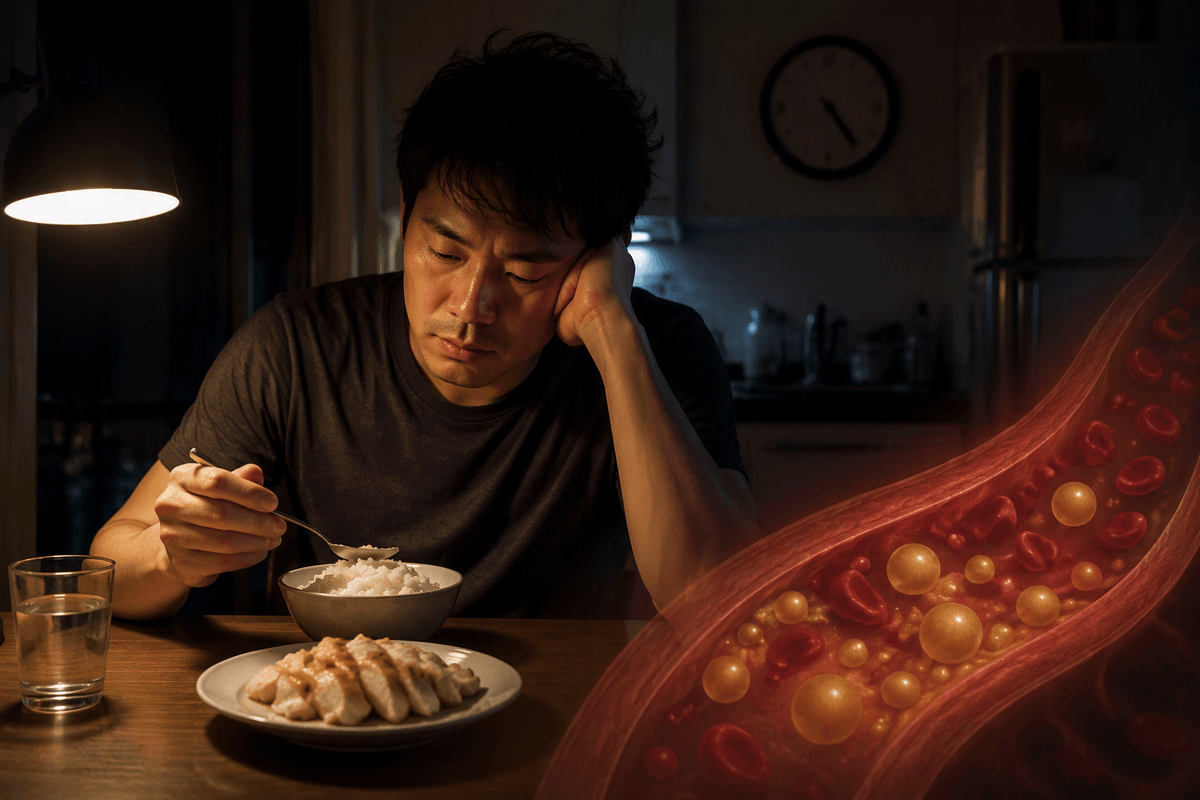
You notice it most when you try to be “good” during the day and then eat a familiar meal late—maybe the same bowl of rice and chicken, the same sandwich, even the same takeout order. It doesn’t feel heavier, but your body can react as if it is. At night, you’re often coming off a long gap, you’re more tired, and you’re closer to being still for hours. That combination can make the after-meal rise in blood fats linger longer than it would earlier in the day.
Part of the mismatch is that the same carbs and fats land on a different background. In the evening, your muscles may be less “hungry” for incoming glucose, so more of that extra energy gets redirected—first into storage, and sometimes into triglyceride-rich particles your liver sends out. That doesn’t mean your LDL changes overnight. It’s more that a repeatable late-meal pattern can keep triglycerides elevated more often, even when the food itself doesn’t look unusual.
Fiber, fats, and bile acids form a feedback loop
You can feel it in small ways first: a heavier, slower-after-lunch kind of fullness, even when the meal looked “balanced.” Sometimes it’s a salad that somehow doesn’t stick with you, or a sandwich that does—depending on what else was on the plate. That’s where fiber quietly changes the math. It doesn’t just “slow digestion.” In everyday terms, it can change how much fat and cholesterol your gut sends back into circulation versus how much leaves your body.
Bile acids are one of the main tools your liver uses to handle fats. They get released into the gut to help break down a meal, then a lot of them are re-absorbed and recycled. When meals are low in soluble fiber (oats, beans, lentils, many fruits), more of that recycling tends to stay efficient—meaning the liver doesn’t have to pull as much cholesterol out of the bloodstream to make new bile. Add in frequent saturated fats, and the “recycle and reuse” loop can tilt toward higher LDL over time. It’s not loud or immediate; it can look like nothing changed, except the routine did.
Snacking patterns can quietly raise triglycerides

It often starts as something that doesn’t even register as “eating.” A handful of crackers while you’re cooking, a sweet coffee on the drive home, a small bowl of cereal because dinner was late. None of it feels like a meal, so it’s easy to assume it won’t show up on lab work. But snacking can keep your body from ever getting a clean stretch of “between meals” time, especially when the snacks are mostly refined carbs or sugary drinks.
In that stop-and-start pattern, insulin keeps getting nudged back up, and the liver may keep turning extra incoming energy into triglyceride-rich particles rather than clearing what’s already circulating. The confusing limitation is that it’s inconsistent: a few snacks on a busy week might not matter much, yet a repeating nightly “just something small” can act like a second dinner. Triglycerides don’t always rise because the snacks are huge—they can rise because the quiet rhythm never really lets the system settle.
When “healthy” changes create confusing lab results
The confusion often shows up after a week that felt “clean.” You swapped chips for trail mix, started using coconut oil because it sounded better, added a protein shake, cut back on breakfast to “give your body a break.” Then the lab report comes back with LDL a little higher, or triglycerides that didn’t budge, and it feels like the numbers are ignoring your effort.
Part of the mismatch is that “healthy” is a label, not a nutrient pattern. Some upgrades raise saturated fat without you noticing (certain coffees, cheeses, coconut-based products), which tends to track more with LDL over time. Other changes add liquid or snack-like calories that keep showing up late (smoothies, bars, dried fruit), which can act like extra carb hits and keep triglycerides stubborn. And if weekdays are structured but weekends swing between restriction and rebound meals, the average your liver responds to can be messier than the intention behind it.
What makes cholesterol responses vary so much
Sometimes the only clue is that two people can copy the same “better” lunch—same salad, same chicken—and get different lab trends a month later. One person feels steady; the other feels hungrier at night and starts adding a few more snacks without calling them snacks. Cholesterol numbers can end up reflecting those side-effects of a routine, not the headline choice you remember making.
Part of the variation is timing, part is what your body does with leftovers. If most calories land late, triglycerides may stay touchier even when the food looks reasonable. If the routine is quietly higher in saturated fat and lower in soluble fiber, LDL may drift up even without big portions. Sleep, stress, and alcohol can also blur the picture—less by “causing cholesterol” and more by nudging appetite, late eating, and the kinds of foods that feel easiest. The pattern can be real even when any single day looks fine.



![10 Best Money Apps for Teens Under 18 [Invest, Pay + More]](static/image/2026/09/01/3f428ab8-8307-404d-a595-f709507802d9.png)