You didn’t “overspend”—your bank just charged you
The month looks fine until the last week, when a $9.95 “service fee” lands and suddenly the grocery run feels like the mistake. It’s easy to read the lower balance as overspending, especially when the transactions are ordinary. But the pattern is usually quieter: a balance dipped below a threshold for two days, direct deposit posted a day later than expected, or a transfer came out before payroll cleared. The timing, not the lifestyle, is what tips the account.
Pull up the last two statements and circle anything that isn’t a purchase: maintenance fees, overdraft/NSF, out-of-network ATM charges. Add them. If it’s $20–$60 some months, that “extra spending” story starts to fall apart—and it becomes a rules problem that can be fixed.
First mistake: opening the wrong account for your habits

The first place people get trapped is right at signup. The account looked “standard,” the banker clicked the box, the app promised early payday—and the fee waiver was tied to a behavior you don’t actually have. A checking account that waives the monthly fee with $1,500 in direct deposits sounds easy until your pay schedule is irregular, you’re paid by ACH from multiple clients, or the deposit hits after the statement cycle closes. For someone who keeps $300–$800 as a working buffer, a $1,500 minimum daily balance requirement isn’t a preference issue; it’s a mismatch that produces a predictable charge.
Match the account rules to what your month really looks like. If your balance routinely dips, prioritize an account with no minimum balance and free overdraft protection via savings (or an opt-out of overdraft for debit purchases). If you rarely use cash, don’t “pay” for a big ATM network you won’t touch. And if your paycheck timing is the variable, the best waiver is the one that doesn’t depend on perfect timing—because timing is exactly where banks make their money.
The domino effect when your balance runs too low
Once the buffer gets thin, the account stops behaving like a simple ledger and starts acting like a chain reaction. A small purchase posts, the balance slips under the bank’s “minimum daily” line, and the monthly maintenance fee is now back on the table for the cycle. Then an autopay you forgot about hits overnight, and the bank decides whether to decline it (NSF) or pay it (overdraft). Either way, there’s often a separate fee, and sometimes a second one if the merchant retries the same bill two days later.
The frustrating part is that the trigger is usually timing, not size. Deposits can credit later in the day while debits settle early; weekend holds can stretch a low-balance window; and pending card charges can mask what’s actually available. If your typical cushion is $300–$800, even one mis-sequenced transfer or a delayed paycheck can turn into $35–$100 in charges before the month resets.
This is why “just keep more in checking” isn’t a clean fix. Parking $1,500 to avoid a $9.95 fee may still lose to a single overdraft, but moving too much out can make the dominoes easier to tip. The practical win is identifying which rule you keep tripping—minimum daily balance, overdraft coverage settings, or autopay timing—then adjusting that one constraint first.
Cash withdrawals: convenience fees you only notice later
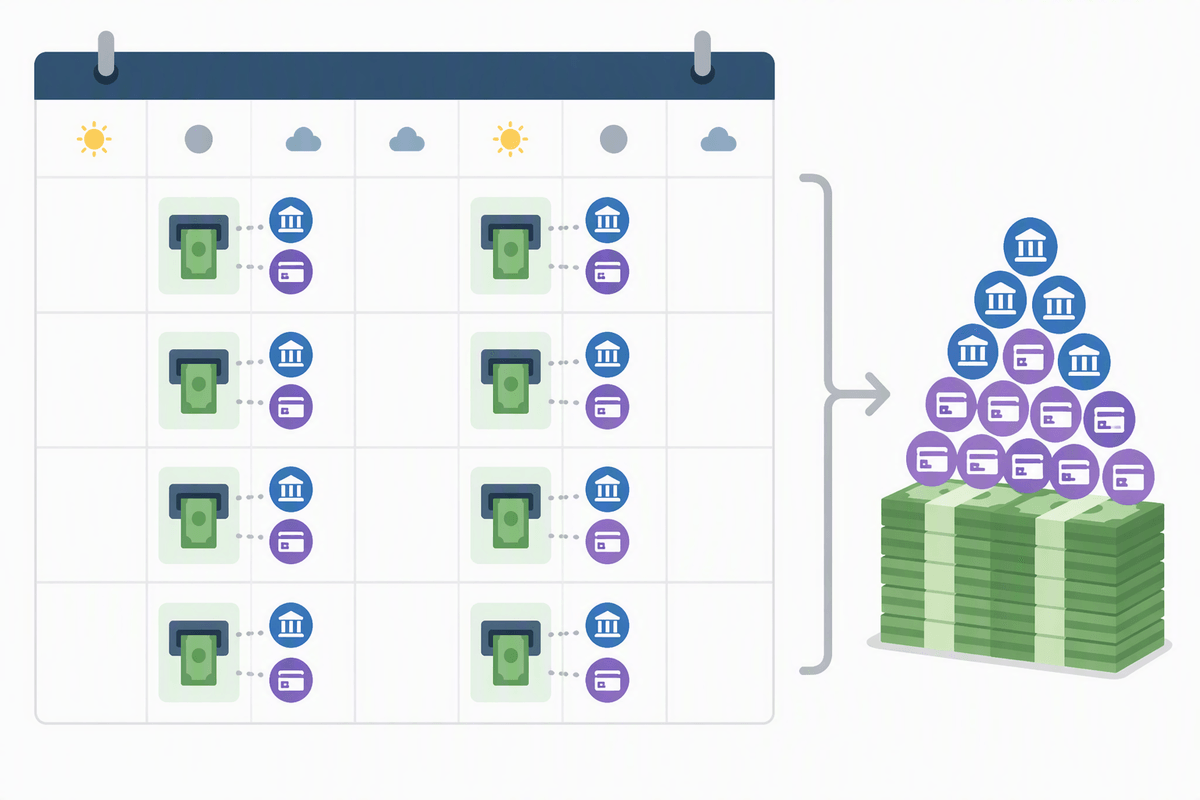
Cash is the fee category that sneaks in because the damage is split across two lines. The receipt shows “$60,” but the statement later shows “ATM fee $3.50,” and then a second “non-network ATM surcharge $2.50” from the machine owner. If your bank also treats certain cash withdrawals as “cash-like” (especially at some event venues, or international ATMs), the withdrawal can drag in a higher fee schedule or a foreign transaction markup that doesn’t show up until settlement.
The constraint isn’t willpower; it’s access. If you pull cash twice a week because tips, barbers, babysitters, or weekend markets still run on bills, those $5–$8 hits compound into real monthly leakage. The clean test is to map where you actually withdraw: if it’s the same two places, switching to a bank/credit union with fee refunds or a bigger in-network footprint is usually cheaper than “trying to remember” one perfect ATM.
Moving money between banks can quietly cost you
After a couple of ATM hits, the next “safe” move is usually shifting money around: keep checking lean, park cash in a higher-yield savings somewhere else, sweep it back when bills are due. The leak shows up in the seams. An ACH transfer can take days, and that float forces a choice—leave extra in checking (risking less interest) or cut it close (risking a low-balance fee or an overdraft if an autopay posts early). If it’s a weekend or holiday, the timing gap widens right when balances are already tight.
Then there are the one-off charges that feel like bad luck until they repeat: wires with obvious fees, “expedited” transfers, and outgoing transfer limits that push you into workarounds. Even when your banks don’t charge, the constraint is operational—holds on inbound transfers, cut-off times, and transfer caps can turn “I moved money” into “my bill hit first.” The fix isn’t moving money less; it’s designing one buffer account and one transfer rhythm that doesn’t depend on perfect posting order.
Bill pay fixes that backfire into new charges
When the balance feels fragile, bill pay starts getting “optimized.” People split rent into two payments, move due dates around, or flip utilities to autopay so nothing gets missed. The surprise is that each fix can add a new timing constraint: a payment scheduled for Friday may actually leave on Thursday, while the paycheck meant to cover it posts later in the day. That’s how a late-fee avoidance move turns into an overdraft or an NSF when the biller retries.
The other backfire is using the bank’s faster options under stress. Same-day bill pay, expedited electronic payments, and “guaranteed delivery” checks can carry fees, and some banks treat certain payees as exceptions with different cutoffs. If you’re going to automate, the cleaner setup is boring: one pay cycle, a small “bill buffer” that never gets transferred out, and alerts that fire before the payment leaves—not after it posts.
When “set and forget” turns into inactivity penalties
A few months after fixing overdrafts and bill timing, the account can go quiet—and that’s when some banks start charging for “inactivity” or quietly reclassify the account. It happens with a backup savings you opened for overdraft protection, a secondary checking you used for transfers, or an old account you kept “just in case.” You stop touching it, statements go paperless, and the only new line items are a small monthly fee or a surprise “account maintenance” charge because the relationship requirement wasn’t met.
The constraint is that “activity” is often defined narrowly: a deposit, a debit, or a minimum number of transactions per cycle. If the balance is small, a $5–$10 fee can erase it before you notice. The practical move is to check the fee schedule for dormancy/inactivity language, then either automate one small monthly transfer or consolidate the account entirely so it can’t become a slow leak.
Your next month: a simple fee-audit and reset
Over the next month, treat this like a controlled test, not a personality change. Pick one checking account as the “hub,” then open a note with four buckets: monthly maintenance, overdraft/NSF, ATM, and transfer/bill-pay fees. Each time a fee hits, log the exact name, the amount, and the date it posted—posting dates are usually where the story is. By week two, you’ll see which rule you keep tripping (minimum daily balance, direct deposit timing, or out-of-network cash).
Then make one reset, not five. Turn on a low-balance alert at a number that gives you two business days of breathing room, move autopays to a single pay cycle, and choose either (a) keep a dedicated bill buffer in the hub account or (b) switch to an account that removes the rule entirely. The goal for day 30 is simple: fewer “surprise” lines than last month.