Your paycheck arrives, yet the money’s gone
The deposit hits on a Friday morning and, for a few hours, everything feels fine. Then the notifications start stacking: the mortgage draft you forgot was “early,” a streaming bundle that renewed, the daycare invoice that posts whenever it posts. By Monday, the balance looks oddly familiar again, and it’s hard to tell whether you spent too much or just got ambushed by timing.
In households with solid salaries, the leak is rarely one dramatic purchase. It’s the cluster of small, confident decisions made in different places—Amazon, app stores, dinners that “don’t count,” autopays set and forgotten—plus bills that land out of sequence. The friction shows up as a real constraint: you can afford everything on paper, but not all at once, and the calendar is the one picking winners.
The ‘steady income’ assumption that quietly fails
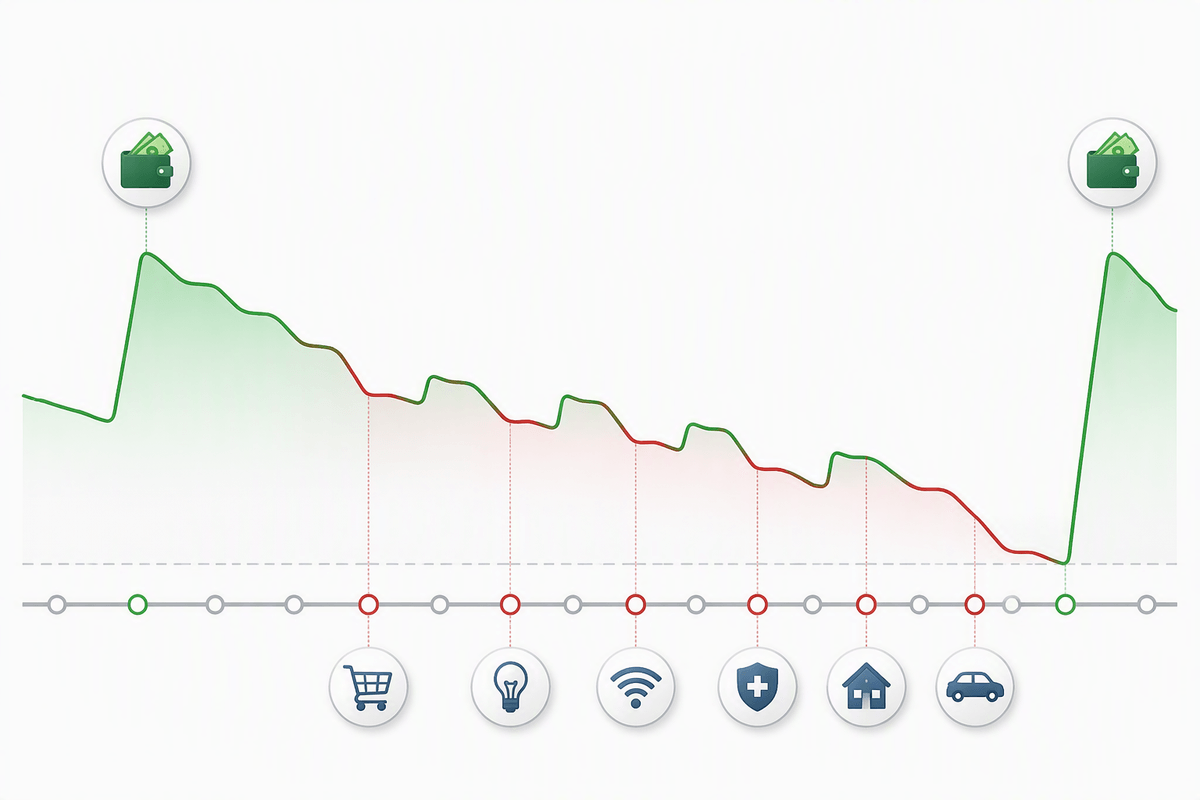
What tends to break isn’t the income. It’s the assumption that a “monthly salary” behaves like a clean monthly cycle. Most salaried households are really running two different systems at once: paychecks arrive on payroll dates, but obligations arrive on merchant dates. When those don’t line up, the same budget can feel either easy or impossible depending on which week you’re in.
The quiet failure shows up in the way people mentally spend. A raise or a second income creates a sense of slack, so categories get funded by vibe: “we’re fine this month,” “we’ll catch up next check.” Meanwhile, fixed costs quietly step up—insurance premiums, daycare rate changes, property tax, annual renewals split into installments—and they don’t ask permission. The constraint isn’t total affordability; it’s sequencing. You can cover everything, but a few poorly-timed drafts force you to borrow from savings or float a card, and the plan starts getting rewritten midstream.
Give every dollar a job before it disappears
After a couple of months like that, the move that changes things is simple but a little uncomfortable: you stop treating the checking balance as “available” and start treating it as “unassigned.” The constraint is timing. If the next ten days include a mortgage draft, a daycare pull, and two subscriptions you always forget, then the dollars sitting there already have claims on them, even if the merchants haven’t shown up yet. Until you decide what each dollar is for, the calendar will keep deciding for you.
Right after payday, you give the money jobs in an order that matches consequences. First, anything that can cause fees or late marks (housing, utilities, insurance, childcare, minimums). Second, the near-term irregulars you know are coming (an annual renewal broken into a monthly “sinking fund,” a car repair buffer, quarterly tax/HOA). Third, goals that are easy to skip unless they’re named (extra debt payoff, emergency fund, a specific savings target). What’s left is actual spending money—groceries, gas, eating out—and it’s smaller than the balance looked five minutes ago, which is the point.
Then you watch the jobs, not the total. When dining out starts climbing by the second week, it’s not a mystery anymore where the trade-off comes from—you move dollars from another job on purpose, or you don’t. The plan becomes a set of decisions you can revise, not a number you hope holds.
Plan for irregular bills like they’re monthly
The next time a “random” charge hits—car registration, the semiannual insurance bill, the friend’s wedding travel—it shouldn’t feel like an exception. It’s predictable in the only way that matters: it will happen again, and it will land on whatever week is least convenient. The constraint is that these bills don’t care that your budget is built on a neat month; they care what’s in checking the day they post.
So you treat them like monthly obligations even when they’re not. Take the known total, divide by the number of months until it’s due, and fund that amount every paycheck as a sinking fund. If the annual auto insurance is $1,200, it becomes $100 a month; if property tax is $3,600 twice a year, it becomes $600 a month. The money isn’t “extra,” and it isn’t “savings” in the motivational sense—it’s a bill on layaway.
Practically, that means the category gets funded before lifestyle spending, and it lives where it won’t get casually spent: a separate savings bucket or a dedicated line item you don’t borrow from without replacing. The surprise goes away, and what’s left is the real trade-off: you were always paying it—you were just paying it in panic.
Trade-offs show up early, not at checkout
Once the irregular bills are getting funded, a new kind of discomfort shows up: the numbers get honest fast. After payday, the groceries category is funded, the gas is funded, the sinking funds are funded—and suddenly the “fun” money is smaller than it used to feel. The constraint isn’t that the household can’t afford dinner out; it’s that Friday night is competing with a real draft date ten days away, and overdrafts don’t care that the charge felt reasonable.
This is where trade-offs need to happen on purpose and early. If you know there’s $320 left for the rest of the pay period after essentials and goals, you don’t wait to discover it at the register. You decide in advance what gets protected (mortgage, childcare, minimums, sinking funds), what gets a cap (dining, Amazon, rideshares), and what gets paused first if something runs hot. The point is to “spend” the discomfort up front, so checkout isn’t where the plan collapses.
Mid-month changes without blowing up the budget

About halfway through the pay period, something shifts: a kid gets sick and you pay for urgent care, a work trip reimbursement is late, the car throws a warning light. The constraint isn’t the surprise itself—it’s that the surprise shows up after you already assigned the dollars. If you respond by “just using the card,” the plan stays intact on paper while the cash flow quietly breaks underneath it.
The cleaner move is a controlled swap. You open the budget and move money only from categories that were designed to flex: dining out, shopping, extra principal, maybe the next sinking-fund contribution if the due date is still weeks away. You don’t pull from mortgage, childcare, utilities, or minimums. If the hit is bigger than the flex categories can cover, you name it as a temporary deficit and schedule the catch-up across the next one or two paychecks, instead of pretending it’s fine.
Then you put a small rule on it: any mid-month move has to include the “from” and the “back by” date. It stops being a derailment and turns into a short-term loan you’re tracking.
The first three cycles that make it stick
The first month you do this, it feels like you’re micromanaging. A category goes negative, you move money, and it looks like “failing” even though nothing overdrafted. The constraint is attention: it’s easy to quit right there, because the old way required less noticing. Instead, treat the first cycle as setup—catch the missing subscriptions, the real grocery pace, the bill you misdated—and don’t chase perfection.
Cycle two is where the stress drops. Your sinking funds start holding real dollars, and mid-month swaps get smaller because fewer “surprises” are truly new. The constraint becomes timing: you may need a slightly higher checking buffer so early drafts don’t force transfers.
By cycle three, you’re mostly repeating decisions, not inventing them. Caps tighten where spending ran hot, goals get funded earlier, and the calendar stops picking winners.